Sunday, August 16, 2009

Karijini National Park ~ 11th-13th August


On the way from Tom Price to Karijini NP we stopped to take a photo of the mountain I climbed. (Well nearly all the way up! I am at last finding the uphill muscles which never seem to get a workout in Koondrook.) This is Mt Bruce.

So here we are in Karijini National Park. We have discovered a fantastic place where mountains and gorges fill the landscape. We set up camp in Dales Campground and headed straight for the gorge.

The first view from the lookout really took our breath away. The cliffs are beautiful and the gorges really deep and scary. A lot of the rock is layered like slate and we walked down to Circular Pool where some people were swimming in the very cold water.


We walked and clambered on up the gorge a few kms, marvelling all the way at the beauty of our world and loving just being here, past lots of Snappy Gums and Paperbark trees, to Fortescue Falls and Fern Pool where more people were swimming in equally cold water.

Back up on top we looked down again at where we'd been. Here you can see Fortescue Falls.


The next day was the day for the challenges of the gorges in the Weano Recreation area.

Once again we marvelled at the view from the lookouts and then made attempts to walk into some of the gorges.

They get wet, slippery and dangerous as this shakily taken photo shows. It is a view of the handrail to help you get into “Handrail Pool” in Weano Gorge. If you want to go any further you have to swim through the pool of very, very, very cold water and enter territory where you need skills that I don’t have!

Hancock Gorge was another beautiful place. To go all the way down this gorge one needs to get wet, too.

The sides of the gorge are truly stunning and are sometimes reflected in the water which flows down the gorge.


During our third day at Karijini NP we explored the lovely relaxing gorge called Kalamina.


We walked for about 3kms enjoying the flat rocks which made for easy walking and the beautiful pools which accompanied us on our journey.


This dragon lizard took up an interesting stance near our campsite. Cute little thing isn't it?

Blessings to you all and we will be in the Pilbara for a little while yet.

Tuesday, August 11, 2009

Mining in the Pilbara ~ early August

Everything in mining in the Pilbara is massive – the companies (Rio Tinto and BHP Billiton), the trains, the trucks, the machines which work the mines, the piles of iron ore and salt, the ships and the monthly payroll. It is easy enough to find out information about mining here so I have not tried to go into any detail; rather I offer you my simple photos of massive things.

A ship being loaded with iron ore at Port Hedland.

The salt has been washed and is poured out into large stockpiles for drying at Port Hedland.

A machine for putting putting a pile of iron ore onto a conveyor belt at Tom Price mine.

We went on a tour of the Tom Price mine. David got into a disused "bucket".

I am standing next to a small front end loader. See the ladder which come down to enable the driver to get into the driver's seat.

The three locomotives of a train coming from the Marandoo mine near Tom Price, heading for Dampier.

We are now off to explore the ranges and gorges of Karrijini National Park, still in the Pilbara, so take care and I can assure you all, my loyal followers, I think of you often and will always remember my friends and family. Blessings to you all and we will see you again on the west coast.

Wednesday, July 29, 2009

Barn Hill 17th July ~ 3rd August


Our Beach Holiday
Walking, swimming, bird watching, beautiful sunsets, interesting rock formations, Sunday night roasts and entertainment. We are thoroughly enjoying being here and have extended our stay twice.

Wildlife
I love to watch the Brown Boobies each morning on the beach as they dive to catch their fish in the shallows. There are Pied Oyster Catchers with their striking red beaks and lots of Terns and Sea Gulls. White-bellied Sea Eagles use this place for their hunting ground, too. I have also seen a pair of Lesser Frigatebirds on a few occasions flying across the water.
It has been really exciting to watch Bottle-nosed dolphins and whales (I don't know what sort) frolicking in the sea.

Blessings to you all and we will be off to Port Headland next week.

Saturday, July 18, 2009

Kimberley 3 ~ 30th June to 17th July

We are currently at Barn Hill on the west coast where the Indian Ocean is our swimming hole and a working cattle station is our caravan park. Before we arrived here we spent a wonderful 9 days in Derby with a 2 day excursion to Windjana Gorge followed by a week in Broome.

Derby


Our first few days in Derby were rest days after which we explored the town, indulged our penchant for bird watching at the waste-water wetlands and discovered the phenomenon of the massive tides of Derby and King Sound, attended several events of the Boab Festival and watched people tossing their pots over the Derby pier in the hope of catching a sizeable Mud Crab. Several times at the pier I saw a beautiful Brahminy Kite.

One of my highlights in Derby was a concert “Telling Stories Through Music” featuring the Aboriginal opera singer Deborah Cheetham and artists from the West Australian Opera. Deborah gained fame by singing at the opening of the Sydney 2000 Olympics. She has written an opera about the birth of the civil rights movement for Indigenous Australians in 1939 which will be debuted in Melbourne in October 2010.

During our stay in Derby we went to the Mowanjum aboriginal community for a corroboree they stage each year for visitors. This community is made up of 3 separate language groups from the area who share the spirituality of the Wandjina. They have a website which can help understand a great deal about their art, history, culture, spirituality and organisation.

http://www.mowanjumarts.com/aboutus.html

We were treated to a variety of corroborees telling stories about their spirituality. There was also a guest performance by a Torres Strait Islander group which has settled in Derby. I felt really honoured to be there. For the final corroboree dance everyone in the audience was invited to join in and so a large circle of black and white people danced and were joined together in happiness and joyous celebration. They have an arts centre at their community which was opened tonight and houses some amazing art work for sale. I bought a book on Mowanjum spirituality and have been struck by some similarities with Christianity. The Mowanjum people have a living and developing spirituality and a life which embraces much of modern technology. They provide a wonderful place for their children to grow and develop. The children were involved in the corroborees and were as excited as any children would be who are getting dressed up and about to give a concert.


Windjana Gorge

For our visit to Windjana Gorge we packed the caravan tightly and headed off along the notorious Gibb River Road. It was mostly bitumen along the stretch we covered.

After we turned off the GRR the corrugations began and it took us over an hour to do the next 22kms. We were concerned for the caravan but continued anyway looking for the best bits of road and driving slowly to avoid the damage of corrugations.

We set ourselves up in the fantastic camping ground of Windjana Gorge NP, fixed the loose parts of the caravan, cleaned out the red dust and had lunch.

I found a Great Bowerbird and his bower in the middle of the camping ground. It was so neat and clean.

I went for a walk later and made my way into the gorge. What a magic place! I persuaded David to come with me later as the day cooled into evening. We took some photos of the sunset changing the colour of the Napier Range. It turns a beautiful red/brown, rather like Uluru and other ranges we have seen. The colours are vivid at sunset and sunrise, very special times of the day.

On day two I set off early in the morning with the binoculars and the camera and went into the gorge again. The sun was making the place beautiful again. It was cool in the shade and as I arrived at Bandigan rock the sun covered much of the sand and warmed the whole place up.

Later after breakfast we both set out to walk the length of the Gorge walk a distance of 7km return. It was a 5 hour walk for us as we stopped often to look at birds, take photos and marvel at the beauty of the place. We clambered over rocks, trudged through deep sand and scratched our way through prickle bushes. The Lennard River runs through the gorge but there isn’t a real flow of water during the wet season, just some large residual pools joined by a slight flow.

The freshwater crocodiles take advantage of this beautiful place. They sun themselves and swim in the river. They have the north and western part of the gorge to themselves as humans aren’t allowed on that side of the river. It is really a good place to be able to watch the crocodiles in their natural habitat. They are not dangerous unless you interfere with them.

After lunch, when I had recovered from our gorge walk, I took off on the Savannah walk which is a short walk through the savannah grasslands and along the south eastern wall of the ranges. The interpretative signs tell about some of the plants and animals which live around here. I was looking for the Lillimilura Homestead track so that I could visit the ruins of the old police outpost from the 19th century. I walked around all the campgrounds to no avail until I realised that the walk has been closed for some reason. The walk was not in vain though, as just on sunset, yes beautiful again, I saw something moving in the grass at the side of the campground road. There were 6 or so quail feeding and I was able to get a reasonable look at them but I am still not sure what sort they were.

It is truly a lovely place to be.


Broome

We set off very early in the morning to see if we could find a spot to stay in a caravan park in the fabled Broome, the focus of many people’s holidays. We arrived at 8:40am and booked into the Roebuck Bay Caravan Park, finding a place for our new friends here as well. So much for all the stories about not being able to get a place to stay in Broome in July!

On the first night we took our chairs out to the grass along the front of the caravan park which overlooks Roebuck Bay to view the phenomenon known as “Stairway to the moon”. As the full moon rises it reflects on the exposed tidal mud flats at low tide and creates an impression of a stairway to the moon.

For our stay in Broome we wanted to see and do lots of the things which make it a famous place, to find out why it is that some people come here year after year and spend 3 to 6 months.

We have found:

  • Markets – multi-cultural and exciting
  • The famous Cable Beach – 22km of beautiful, clear sandy beach which only sometimes is closed due to crocodiles and where thousands of people come to the beach to view the sunset every day. People take camel rides along the beach at sunset and have photos taken with the magic colours of the sunset sky in the background.
  • An historical exhibition of the Sisters of St John of God beautifully presented and detailing their work here since the early 20th century.
  • A strong pearling history and lots of pearls to buy – from $20 to over $20,000.
  • The working Willie Creek pearl farm.
  • The Broome Bird Observatory which we visited at the wrong time of the year to see the thousands of migratory birds which use the rich mudflats to fatten up for the long flight to a variety of destinations north of Australia, some as far away as 10,000kms.
  • China Town, the main shopping centre of Broome.
  • The deep water port from where live cattle is exported.
  • And the Lighthouse where the ospreys have taken over one platform of the tank-like structure for their nest and where some young over-testosteroned young men found rocks from which they jumped into the swirling and dangerous surf.

Some people come to Broome every year just to enjoy the warm winter here.

Barn Hill

From Broome we have decided (although all decisions are subject to change without notice!) to follow the Warlu Way to Coral Bay.

http://www.warluway.com.au/

Our first stop is a relaxing beach holiday here at Barn Hill. This farm-stay spot, on a working cattle station, is more than a caravan park. It has its own little recreation area where you can sit with friends or enjoy a little “something” from their very homely shop. Often they have something “on” for tea. Tonight it was a sausage sizzle, Sunday it will be a roast dinner and on Wednesdays they light the BBQ for people to bring their own meat and cook and spend time together. Today they also had a bowls tournament (bare feet essential) on their very own bowling green. This lasted all afternoon and judging by the standard of competition there are many bowlers on holiday.

I expect to spend much time on the beach here before we leave on the 24th July.

Blessings to you all and we will meet again somewhere along the Warlu Way.

Sunday, June 28, 2009

Kimberley 2 ~ June 22-28

Halls Creek

In Halls Creek we booked into the only caravan park in the town and set up in one of the few shady spots before going out to explore the China Wall.

Not having read up on this local phenomenon we stared at the strange white wall standing up in the middle of the limestone ranges discussing whether it might be natural or constructed by humans. Then we turned around and saw another one. It’s got to be natural we decided and learned later that it was a vein of white quartz, naturally occurring in this limestone formation. It looks like a deliberately constructed wall which makes its way up and over the hills, giving it the appearance of the Wall of China. (Not that I’ve ever seen the original!)

We travelled on out to the site of the old Halls Creek township which started life in the 19th century as a gold mining town. Remains of the old Post Office still exist; it was made of a mud mix of spinifex and ant bed, protected now by a cover and walls which allow one to look without touching.

We encountered some Road Trains along the Duncan Hwy between Halls Creek and Old Halls Creek. Big, dust creating trucks. We used the UHF and looked along the road for their tell-tale dust plumes so that we wouldn’t be trapped at the edge of the road. There isn’t enough room on the road for both of us. They travel down the centre of the road at such a rate of knots you have no choice but to get off, close all windows, doors and vents and wait for the dust to settle. Now we know why the first 20 metres of vegetation along the edge of the road is so dirty. (By the way, if you click on the photo of the big truck you should see the movie.)

Wolfe Creek Crater

The next day we got up early and, with a packed lunch, made our way out to look at the Wolfe Creek Crater which you get to via the Tanami Road. We are getting used to letting down the tyres to reduce the damage caused by corrugated and otherwise crappy roads. The Tanami itself wasn’t too bad but then we turned off on the Wolfe Creek Crater road! It was AWFUL. The corrugations must have been six inches deep in some places and it took us over an hour to do this last 20 kms. Just as well we enjoy the actual drive and the scenery.


Wolfe Creek Crater itself was interesting but really just a big hole in the ground with vegetation in the middle of it. Having come all this way, I was determined to do everything possible while we were here, so I climbed down into the crater, heeding the warnings to take care as the track was very slippery, steep and rocky. I took only what I needed – water, binoculars and camera in my bum-bag so that I could hold onto rocks if I needed. 20 metres almost straight down and then a walk along the base of the crater, dodging the spinifex, where I was not rewarded by seeing any of the Major Mitchells they say are around. It is amazing to visualise the impact over 300,000 years ago of a meteorite crashing into the earth and making this big hole, splattering fragments of rock which have been found over 4km away. Imagine the thud!

It was a long way home, too. The corrugations put me to sleep at one point!!

Fitzroy Crossing

Fitzroy River Lodge, the caravan park we found in the little town of Fitzroy Crossing is like an oasis in the sparsely populated but beautiful land of the Kimberley. The distances here are vast and the land is harsh. The extremes of wet and dry govern the land. All the structures in the caravan park are built either on hills or stilts, so you have to climb a hill to use the ablution block, climb a hill to go to the reception or the restaurant and even the swimming pool. In the wet season everything floods except for these buildings which are beyond the reach of the high water mark.


The seasonally diminished Fitzroy River is close by so I took off one morning to see what birds were to be found. I didn’t see much to start with but then I thought I saw something move. Probably only a bit of rubbish blowing in the wind, I thought. Instinctively the binoculars went up anyway and I was rewarded for the effort. A Black Fronted Dotterel with a bright red beak and eyes was feeding along the bank. Can you see it in this photo? There were some interesting tracks on this sandy part of the river and I kept a watchful eye out for the Freshwater Crocodiles which live here. My other delight on this beautiful morning was seeing the Striated Pardalotes flying in and out of their nesting burrows in the river bank.

Geikie Gorge

Geikie Gorge is one of the main places of interest close to Fitzroy Crossing and you cannot see much of it without going in a boat. The DEC runs boat cruises at a reasonable cost so we got up very early one morning to get on the first cruise. (I like to see the wildlife early in the morning.) Geikie Gorge is the result of the Fitzroy River carving a 30 metre deep gorge into the remains of an ancient limestone barrier reef that existed here in the Devonian period. In the wet season the water of the Fitzroy River rises 16m through the gorge and covers the whole of the National Park. The water constantly rising and falling has caused the bleaching of the gorge walls as you can see in this photo.

We saw lots of freshwater crocodiles on our trip and I was treated to my first sighting of an Osprey. The crocs were sunning themselves on the sandy banks and the Osprey was soaring and diving, probably looking for food.

After the boat tour we went for a couple of short walks around the area and were able to see more of the Devonian Reef formations … and more birds.

Tunnel Creek

While in Fitzroy Crossing we took a day trip out to see the natural phenomenon of the Tunnel Creek. This is a long tunnel carved out of the limestone of the Napier Range by flowing water. During the dry season it is possible to walk the length of the tunnel which we did, getting wet feet, climbing over large boulders and carrying our torch. There are bats which live in the caves although we didn’t see any and there are some pretty cave formations - stalactites and shawls. We didn’t see any crocodiles (freshwater) but we did see lots of small fish in the water. We waded up to our knees through some of the pools and came out the other end to see a beautiful creek, some rock art and kangaroos which came down to the creek to drink. The only way out is back through the creek cave. Not nearly as eerie the second time! We read the sad story of Jandamarra the Aboriginal who was killed at Tunnel Creek. Here is an internet link if you want to read it, too.

http://www.dec.wa.gov.au/hotproperty/property/national-parks/tunnel-creek-national-park.html

Still in Fitzroy Crossing on Saturday and the footy oval was the place to be. The playground here was filled with young children playing on the equipment. Family groups sat on rugs around the perimeter of the oval watching the game cheering or just chatting. The first thing we noticed about this footy match was that footwear was optional. Over the loud speaker came a request for someone from the Magpies’ team to help with the stretcher. The game resumed and it really didn’t matter about boots. The kicking was just as long and hard. Another announcement, “Would the drink boys please put on their green shirts … properly!” Then, “Would all the guys please wear their uniform. Mr Waters, please put your uniform back on.” One of the umpires put his uniform back on. Shirts are obviously compulsory even if socks and boots are not!

Blessings to you all and I’ll see you next time on the west coast.

Saturday, June 27, 2009

Kimberley 1

Our tour of the Kimberley started in Kununurra and will eventually take us to Broome mostly along the Great Northern Hwy. We won’t be “doing” the Gibb River Road as a whole, just travelling along a small section of it. The Kimberley is a vast area of Australia and we have travelled lots of kms over excuses for roads variously called highways, roads or tracks.

18/6 – Keep River National Park

While in Kununurra we drove back east over the WA/NT border to spend a day in Keep River National Park where we went on a much longer walk than we intended due to poor signage or making a mistake but there were no complaints as we identified 52 different kinds of birds, 4 of them new for me.

20/6 – Parry Lagoons

While in Kununurra we took a trip out to Parry Lagoons where we saw 3 brolgas even before we got out of the car! This was a magic place, overwhelmingly beautiful, peaceful though not quiet.

Here are my notes. WARNING – they are very birdy!
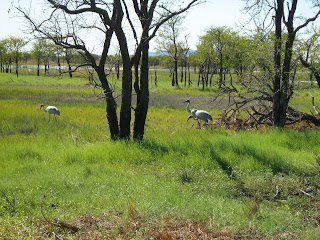
What a magic place we have visited today! We parked the car and right in front of us were some brolgas feeding under a tree.

We turned our heads and saw Jabirus. It took a while to walk to the bird hide, not because it was a long way, but because there was so much to see. It was such fun to watch the Pelicans feeding in their large groups, swimming in unison, then heads down and tails up, again in unison.

2 Jabirus arguing. The one which won flew off with the fish hanging out each side of its bill.

A Glossy Ibis flew by. Was it really? I haven’t seen one before. But yes. I was right. I saw it again later on.

Lots of Straw-necked Ibis, Purple Swamphens and Green Pygmy Geese. A little Restless Flycatcher in the tree near the lagoon. Lots of Willie Wagtails and the beautiful Rainbow Bee-eaters having their fill of insects.

Beautiful White Rajah Shelducks and a multitude of Magpie Geese. Cormorants hanging in trees looked like bats.

There were Black Cormorants, Pied Cormorants and Darters. We watched a darter catch a fish; so snakelike their necks.

One bird was different. We saw just the one. It was a Red-kneed Dotterel.

So many Egrets, Great and Intermediate. So graceful in flight.

Some ducks even swam and looked for food underneath the grating of the bird hide.

The whiskered Terns flew without tiring over the lagoon looking for food. Australasian Grebes and Black and Hardhead Ducks swam peacefully on the lagoon.

The Cormorants on the bank moved generously out of the way as a 3.5m Estuarine Crocodile swam slowly to take its position on the bank to sun itself.

Just then a tour bus arrived so we retreated outside the bird hide for a while, saw a goanna near our car and spent more time watching the juvenile Nankeen Night Heron feeding at the edge of the lagoon.

Later, after a feast of birds, we drove into Wyndham where we went to the lookout to see the view of the 5 rivers wending their way into the Cambridge Gulf.

On the way home we took a trip on one of those excuses for a road and visited the prison boab tree. It is alive and hollow. They say about 1500 years old and was used as an overnight prison cell for police travelling with prisoners. I stepped 17m around the base of the trunk but was a bit out from the edge so maybe it is 15m in circumference.

21/6 – Purnululu National Park
Today’s was a massive drive, not in kilometres but in time. We had driven from Kununurra to Warmun and then out to the track into Purnululu. The 52km from the highway into Purnululu Visitor centre is a 4WD track, an exciting drive of corrugations (That’s not the exciting bit!), rocky track, water crossings and absolutely stunning country. We were later than we wanted to be and in retrospect it would have been fantastic to camp overnight, experiencing the sunset and sunrise of a very beautiful place. Having been here in 2007 and already seen the Beehive Domes and Cathedral Gorge, we had planned to visit Echidna Chasm and the Mini Palms Gorge. The roads within the park are as bad as the one coming in so the 20 km to get to Echidna Chasm took another hour, meaning that the Mini Palms Gorge was out of the question. Time was short as we wanted to get through the worst of the 4WD track out before dark. Enough about the time we didn’t have due to lack of foresight and on to the beauty of the trip we did have.

The country is wild and vast. There is so much of it and it is forever changing. There are acres of spinifex, beautiful sandy creek beds, ranges of sandstone, more acres of trees – palms, red gums, boabs and plenty I don’t know – even more acres of paddocks of rocky ground, red dirt and amongst it all someone has found and allowed us to visit this amazing chasm.

We walked along a dry rocky creek bed lined with palm trees into a chasm with 200m high walls where the palms suddenly got very tall. The walls of the chasm are made of a conglomerate rock. It looks like a whole lot of little round rocks cemented together. I’m sure a geologist would explain it better. And the colour is red, pink, orange, brown, ever changing with the way the sun shines on it … beautiful. The walls of the chasm narrowed as we walked into it. It began to get a bit scary. One of the signs warned against climbing any of the walls or remaining underneath the sheer walls of the chasm! What did that mean? Memories of the collapse of London Bridge on Victoria’s southern coastline (I jumped up and down on it proclaiming its permanency.) came flooding back and all of a sudden I was no longer feeling comfortable or safe. I took lots of photos and didn’t linger too long in this majestic, skinny chasm.

Outside again and we climbed to the lookout at the top of the Osmand Ranges. Yet again I had an overwhelming feeling of awe and wonder at the majesty of our earth and the forces of nature which shape such places.

It was getting late so we jumped in the car and drove back along the excuse for a road to take a look at the surrounds from the Kungkalanayi Lookout which affords a 360o degree panoramic view of the Purnululu National Park. This is where those who are camping the night will bring their evening cockatails to enjoy the sunset. We’ve seen it in other places, the magical and visible change of colour of the rocks in the ranges. Sunset happens quickly in the north. It’s as though someone has a fast motion dimmer switch on the earth and rather than linger through the half light it just goes out. Darkness.

Half of our drive back through the park necessarily was done in the dark but we had the creek crossings done before it turned black and fortunately we came accross the bulldust at a very slow speed. You can’t see the rocks underneath the soft sand and have to be particularly watchful.

Another spectacular day.

Blessings to you all and I will post my notes from Halls Creek and Fitzroy Crossing very soon.

Friday, June 12, 2009

Litchfield and Kakadu National Parks

1st - 10th June

As I sit here in a Caravan Park in Katherine writing my blog the beautiful song of a Butcherbird fills the air while some Apostlebirds screech and scratch around under the trees.

We had a wonderful 9 days in the National Parks of the north – Litchfield and Kakadu.

The creeks, falls and rock pools of Litchfield delighted, awed and relaxed us for four days. An extract from my journal makes an effort to express some of the magic of a small part of this place:

Tuesday: From Buley Rockhole we walked along a beautiful track sometimes following the Florence Creek, sometimes walking through the woodland, all the way to Florence Falls.

What a fantastic view of the falls we had from way up high. We walked down 135 stairs which someone had kindly constructed for us to go for a swim in the plunge pool. On the way down we saw a Short-eared Rock Wallaby which everyone including myself had to photograph. We were very hot and wet before we got into the pool. Some big rocks in the middle of the pool enabled us to stand up but most of it was quite deep. We swam all the way across the pool to where the water plunges down the cliff. I loved the scary noise and feel of the water pounding down even though it was quite disorientating.

Later we had our lunch by Florence creek feeding the little fish tiny crumbs from our sandwiches. It was fascinating to watch them all grab at it, fighting for any tiny crumb they could find. They did the same if a leaf fell from a tree. Perhaps there are insects on the leaves. By the time we had returned to the cascading pools of the Buley Rockhole we were hot and wet again so we sat in one of the pools there until our skin was wrinkled.


Kakadu has been a wonderful place to be in. We didn’t intend to stay this long but after 5 days we have become familiar with being in the midst of this beauty, the rainforests, the sandstone rock formations, the monsoonal wetlands and the grassy billabongs. One very hot afternoon we spent at the Jabiru swimming pool, the only place to swim in Kakadu apart from Jim Jim.

I have seen and managed to photograph a crocodile swimming down the East Alligator river but far more exciting were the iridescent colours of a Rainbow Pitta bird I saw and snapped in the dark basement of the rainforest Manngarre walk. It is the wildlife of Kakadu which enchants and astounds and the scenery which takes one’s breath away again and again.

We learned a little of Aboriginal culture at the Warradjan Aboriginal Cultural centre and from our presence in this very Aboriginal part of our country we are starting to appreciate the depth and complexity of their society and way of life and the respect they have always had for the country we live in. Theirs is a history we cannot learn in an afternoon.

Jim Jim Falls was another 4WD trip. (I love 4WD trips!) We left our Mardugal campground and some distance down the Kakadu Hwy we turned off and drove 60km mostly along a gravel, lightly corrugated, dusty road before hitting the sand, the rocks and the water which made the drive as exciting as the scenery along the escarpment was beautiful. At the first water crossing I balked and handed the steering wheel to David. Of course this gave me an opportunity to photograph the exercise. Jim Jim creek itself is a wonder to behold. The palms around the pools of water make it a very pretty place. It was a difficult climb/walk across boulders along the gorge to the beach and plunge pools and we certainly noticed some new muscles in our thighs.


The water doesn’t fall over the cliffs later in the dry season but there was still a little for us to see pounding over and down these spectacular 150m high cliffs. Some tiny frogs were jumping over the rocks near the plunge pool where we dangled our feet in the cold water. I drove back through ALL the water crossings!

The photo below shows our van in the Mardugal Campground, Kakadu.


Still as I sit and write the birds are all around. Some Grey-crowned Babblers have joined us. The Butcherbird is still singing and has been interrupted a few times by a Blue-faced Honeyeater. A pair of Great Bowerbirds is sitting in the tree and the White-bellied Cuckoo-shrikes are flitting around the trees.

Blessings to you all and we will see you next time in WA.